.svg)
How can New York be a more human place to live?
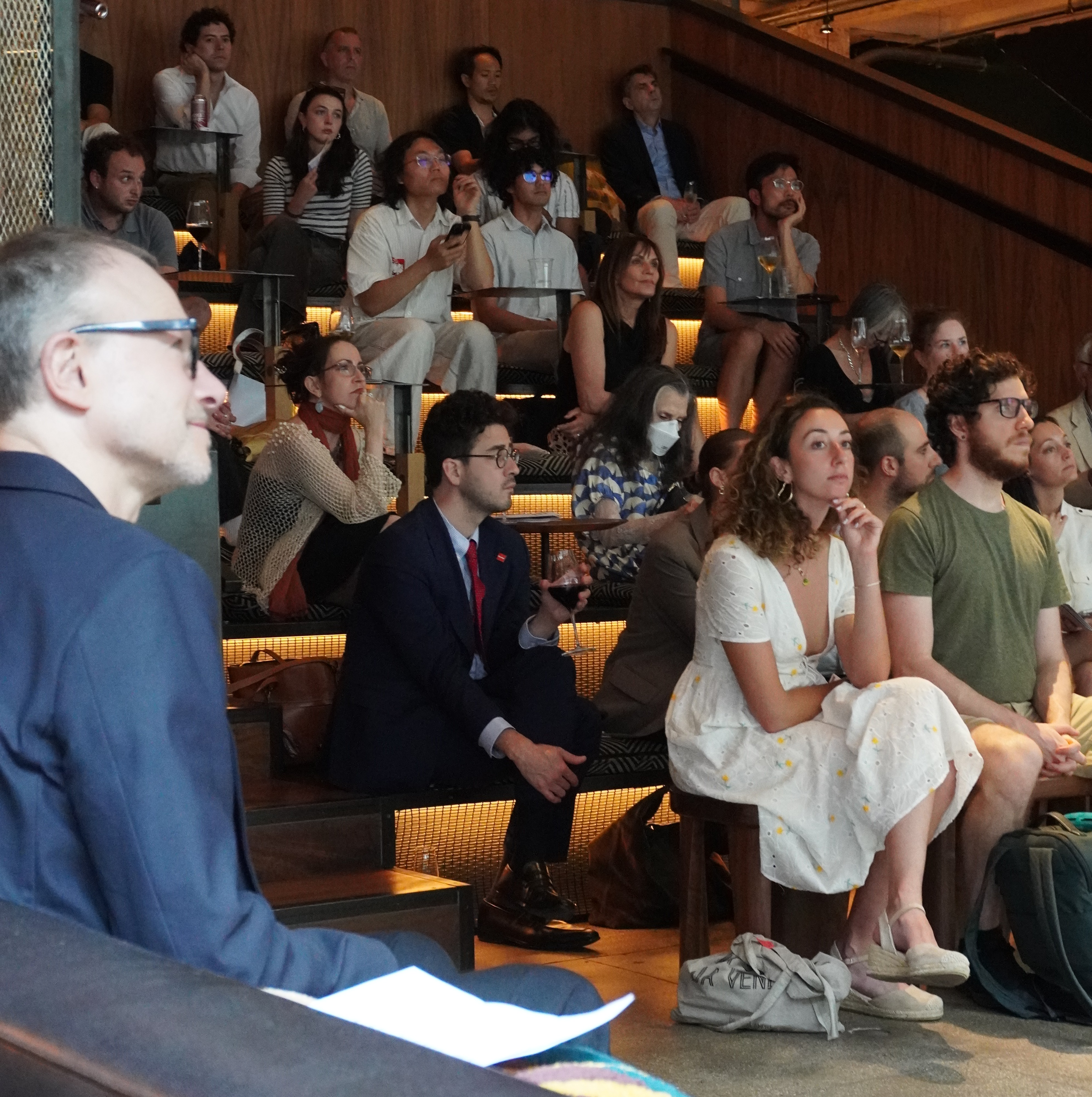
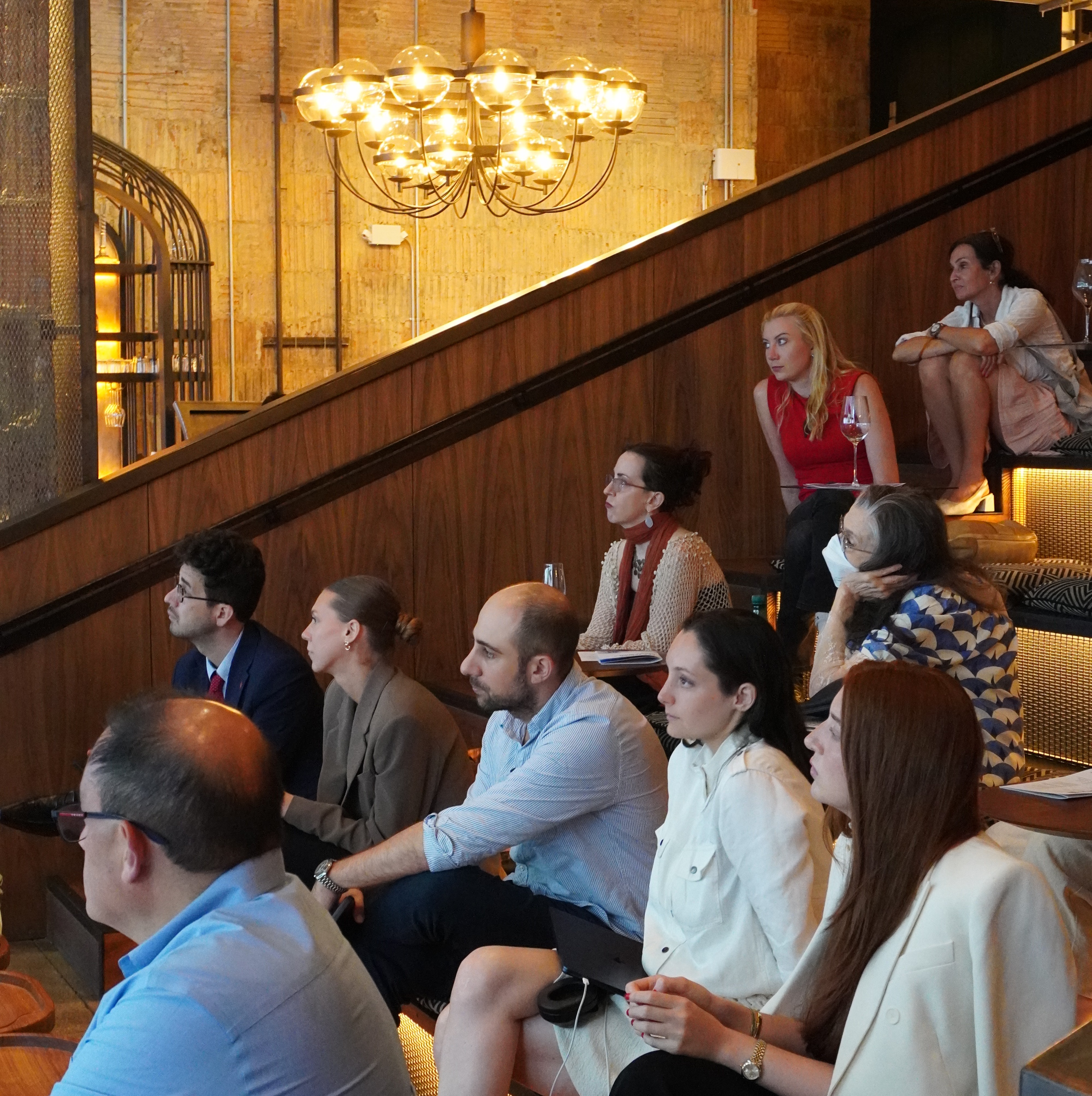
That's the question we gathered to sit with, at NeueHouse in New York, on June 30.
We hosted this conversation at NeueHouse in New York, and we invited three people whose work we genuinely admire to help us think it through out loud: an architect who's spent years fighting for public space, an executive building a shuttle that has no steering wheel at all, and a professor who ran two of the world's best-known design firms and, to this day, still refuses to own a car.
We started with our own research
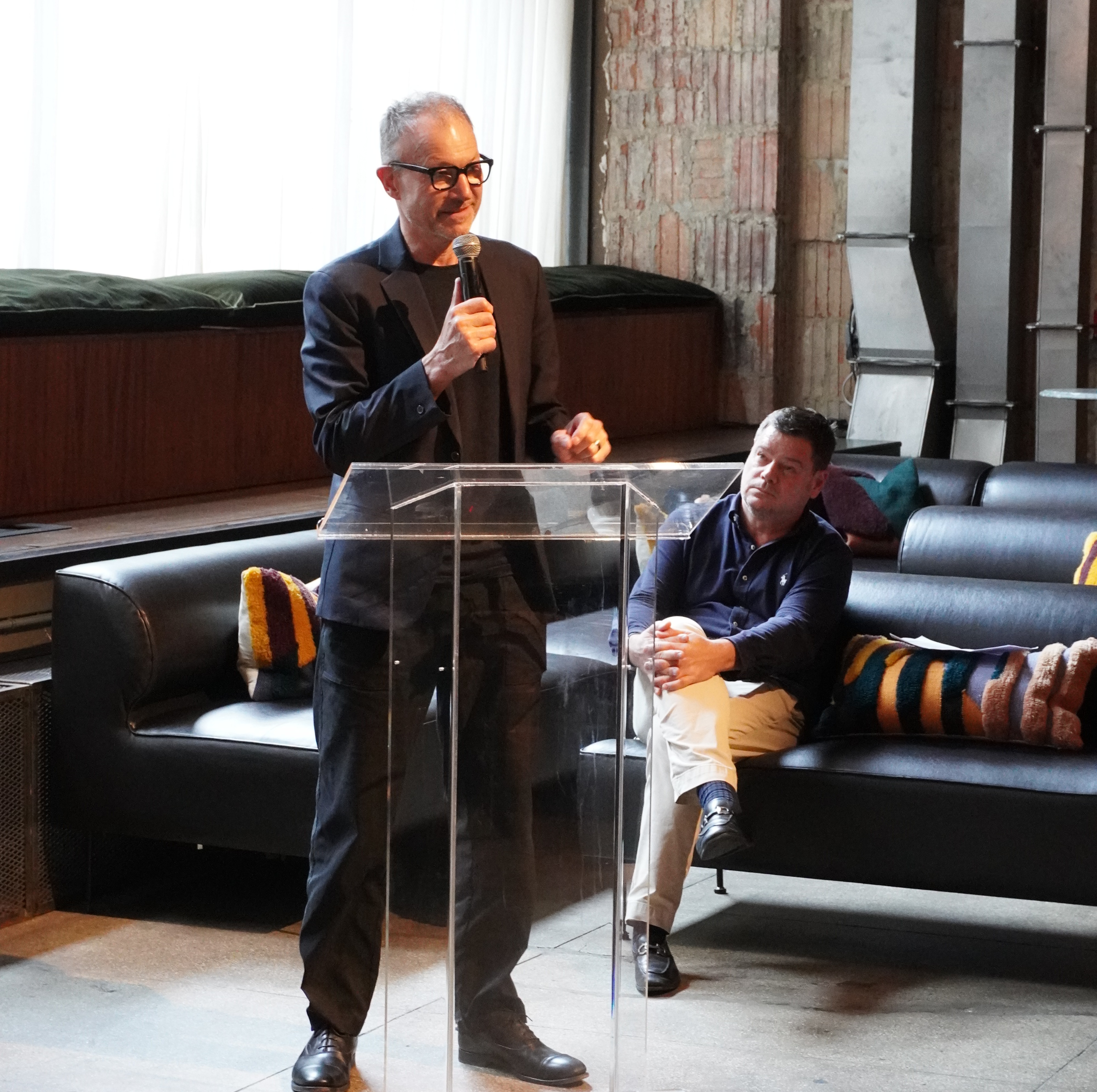
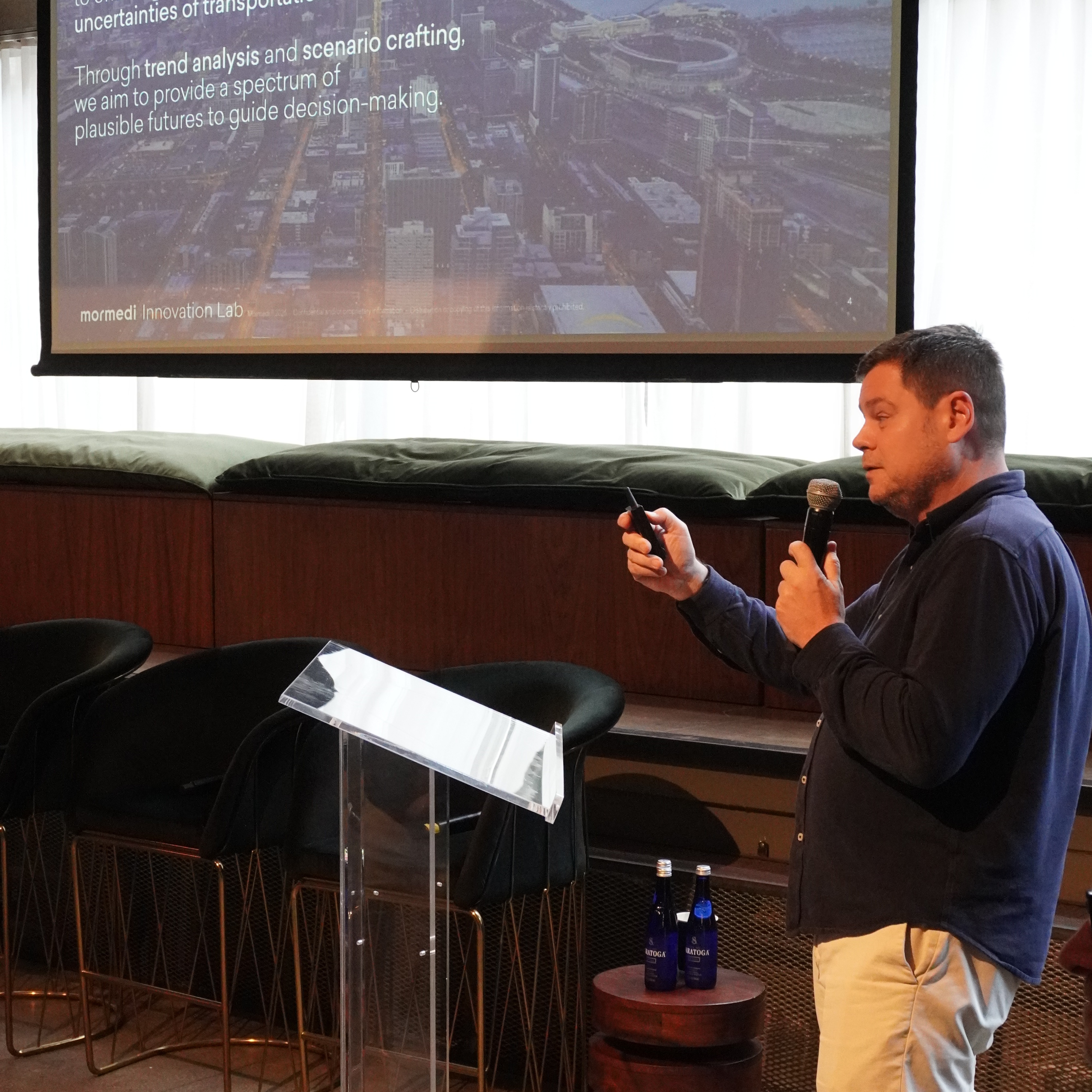
Jaime opened the evening the way he usually does, with a bit of honesty about how hard it's gotten to plan ahead. "We used to plan decades ahead," he told the room. "Now we make decisions based on what's coming next year, next month, even tomorrow." That's really the whole reason we built the Trend Atlas in the first place: a way to separate the signals worth paying attention to from everything else that's just noise.
For this project we pointed it at the year 2050. We looked at 32 cities across five continents, scored each one on things like size, growth, congestion and how strong their public transport really is, and grouped them into five archetypes: leading megacities, green cities, sprawling boomtowns, highway-bound cities, and futuristic ones. From there we mapped eight megatrends, tracked 260 individual signals, and narrowed it all down to 50 trends worth watching.
New York sits in the leading megacity group, alongside London, Paris, Shanghai and Tokyo: dense, wealthy, culturally rich, full of people who already default to walking, biking or the train. Jaime didn't try to answer his own questions that night. He just left them hanging in the room: could better transport and housing make New York more livable? Should it go car-free? Could free buses actually become its backbone? It's the same kind of question we try to sit inside with every client we work with, in aviation, banking, mobility, retail: not what sounds good in theory, but what's actually worth building next.
A bus with no steering wheel
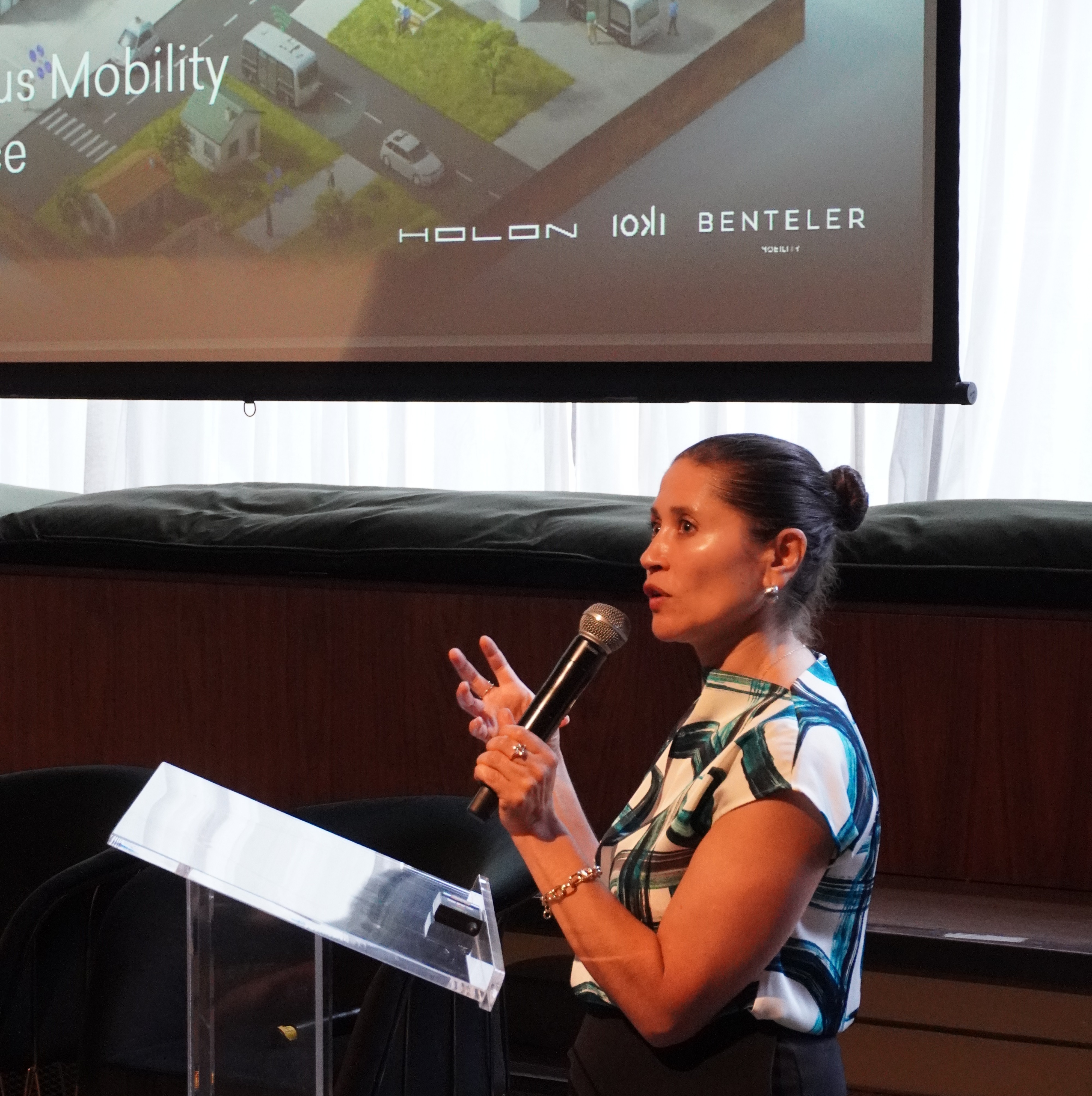
We loved hearing from Paula Bejarano, who leads business development and sales at Benteler Mobility. Her career alone could carry a panel on its own: Tesla, NASA, the European Space Agency, energy, before landing at Benteler, the 150-year-old German group now betting big on autonomous transit through its HOLON brand. She was born in Bogotá and lives in Queens now, which maybe explains why she has such a clear sense of who actually gets left behind by a city's transit map.
The vehicle she talked about looks unfamiliar on purpose. The HOLON urban seats about 15 people, runs fully electric, and was designed by Pininfarina, the Italian house better known for its work with Ferrari. There's no steering wheel and no pedals. It wasn't built by retrofitting an existing car, it was designed from scratch to drive itself, with a ramp and a secured wheelchair space built in from day one rather than added on later.
It isn't trying to replace the subway. It's meant for the parts of a city that never quite got solved properly: campuses, geofenced districts, the last stretch between someone's front door and the train, the bus that runs nearly empty at 9pm because its schedule was built for a different city than the one that exists today. Before a single shuttle goes anywhere, Benteler runs simulations using real commuter and demographic data, so it ends up exactly where it's needed instead of just adding to the traffic.
It's already on the road in Hamburg, through a public-private pilot called Project ALIKE, and Jacksonville, Florida is next, chosen for a friendlier regulator, an unusually open-minded transit authority, and weather calm enough that the sensors don't get confused. When Harry pointed out, gently, that Jacksonville is about as car-dependent as American cities get, Paula didn't blink. That's exactly the point, she said. The families worth designing for are the ones with one car between five people, already stuck with a transit system that isn't good enough. Make the alternative frequent enough, clean enough, safe enough, and people start leaving the car at home, not because anyone made them, but because it finally makes sense.
The real fight is for the curb
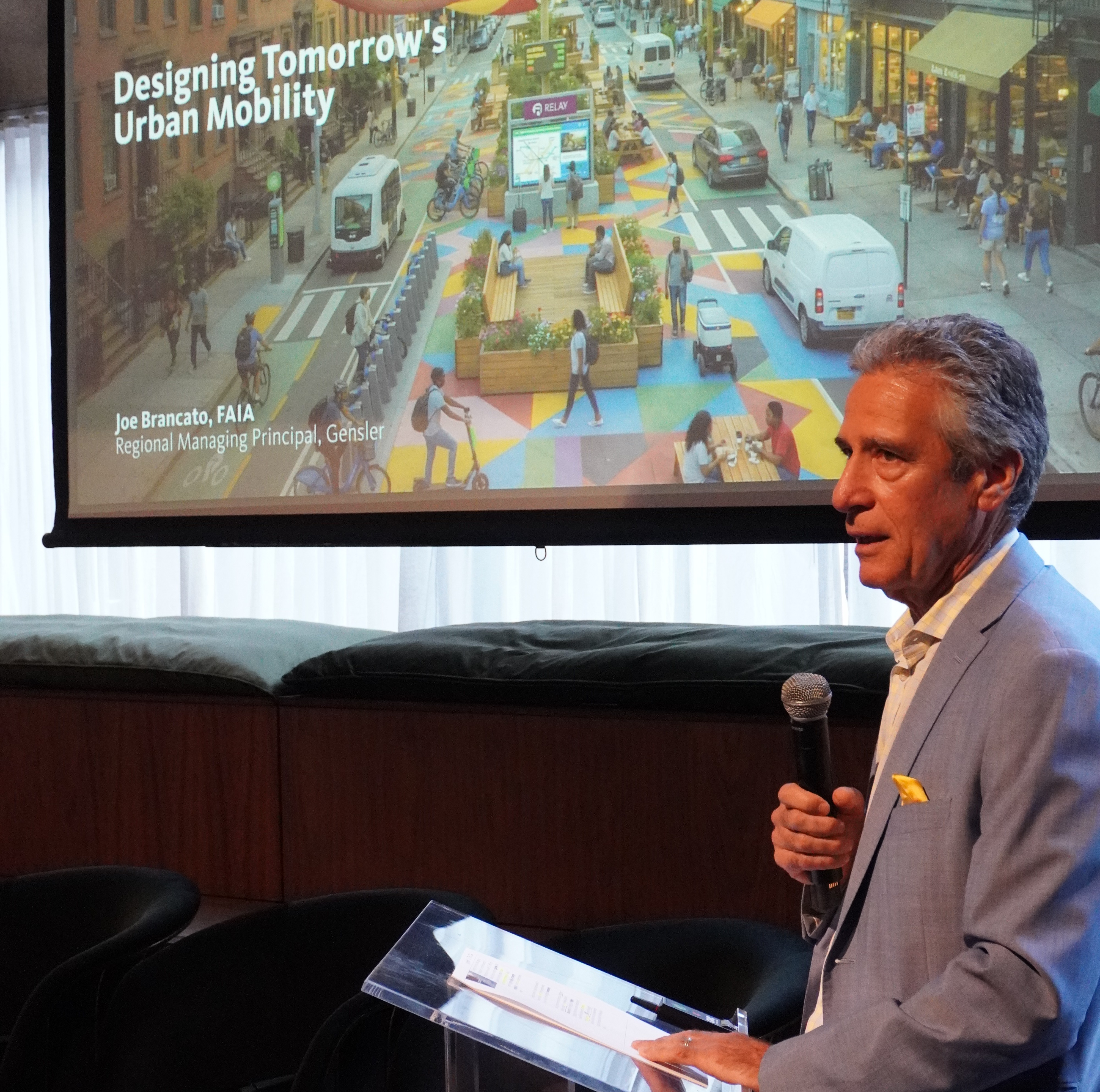
Joe Brancato leads Gensler's Northeast region and chairs the firm's Executive Committee. He's spent decades watching cities negotiate with themselves over space, and he came with numbers from Gensler's own City Pulse survey, one of the largest data sets on urban experience out there: 35,000 residents across 75 cities on six continents. Three out of four people say their downtown offers a genuinely great experience. Fewer than half visit more than once a week.
That gap, he said, comes down to mobility friction, and it's rarely about subways or bike lanes on their own. "The future of mobility really starts at the curb," he told us, pointing out the window at everything competing for the same stretch of pavement: cars, taxis, delivery trucks, scooters, bikes and pedestrians, all fighting for the same six feet.
His bigger point pushed back gently against the instinct to just copy Europe. What works in Copenhagen doesn't automatically work in Queens. So he walked us through cities that solved their own problems in their own way. Bogotá's TransMilenio, just past its 25th year, is still the largest bus rapid transit system in the world, carrying 2.5 million riders a day on dedicated lanes built over roads that already existed. Medellín's cable car, the first ever fully built into a public transit network, carries 220,000 people a day up hillsides the metro could never reach, and it was followed by a 384-meter outdoor escalator in Comuna 13 that did more than move people uphill. It helped bring a neighborhood once emptied out by violence back to life, and opened up 40,000 square meters of new public space around it. Santo Domingo borrowed the idea, wove it into its own metro, and is already building a third line because the first two worked so well.
New York has its own version of this story too, even if it doesn't always get enough credit for it. Congestion pricing, bike-share, protected lanes, the full pedestrianization of Times Square: thirty years of quietly giving car lanes back to people. Gensler's own idea for the BQXL, turning 15 miles of unused freight corridor between Queens and Brooklyn into something useful, was a Fast Company World Changing Ideas finalist. It's now getting closer to real, as the Interboro Express, a proposed $5.5 billion light rail line with 19 stations that would serve more than 900,000 residents in neighborhoods the subway map has mostly ignored.

Then we opened it up to the room
This is usually the best part of any evening like this, and it was here too.
Someone asked why New York is behind Miami and San Francisco on autonomous vehicles. Paula's answer had less to do with the technology than everything around it: the density, a taxi and limousine lobby with real political weight, and self-driving software that's still mostly proven in dry, mild climates rather than a city that sees snow for months. Waymo had actually tested in Manhattan under a city permit and quietly let it lapse a few months earlier, when the path to making it commercially work looked murkier there than in more car-friendly cities. Her bet isn't a Manhattan robotaxi. It's a shared shuttle solving that last mile in Queens or Staten Island, where the need is bigger and the resistance is smaller.
Harry pushed the thread a little further: if shared autonomy really takes hold, what happens to all the space cars leave behind? Joe's answer was architectural. More room to walk and just be somewhere. Public space that flexes through the day, the way Bryant Park already does. And a long, honest look at parking itself: he mentioned a Gensler renovation at One Post Office Square in Boston, where the parking garage next door was deliberately designed so its floors could convert to office space as demand for parking dropped, a quiet bet made years before sustainability showed up in every CEO's shareholder letter.
Jaime got asked what New York could actually learn from Europe and Asia, and he didn't sugarcoat it. Average traffic speed in Manhattan is around 7.5 kilometers an hour, barely faster than walking, and a good part of that isn't private cars at all, it's the roughly two million packages the city absorbs every single day. In Tokyo, he pointed out, you need proof you already have a parking space before you're even allowed to register a car, which does more to curb car culture than any pricing policy New York has tried. He didn't pretend the US would catch up quickly. The attachment to cars here, he said, is cultural before it's practical.
Someone who's spent her career designing for cities across Latin America pushed past the usual Bogotá and Medellín examples and asked what political courage this kind of change actually takes. Joe brought up Michael Bloomberg's twelve years as mayor, especially the years right after 9/11, when the city renovated thirteen parks below Canal Street and rezoned parts of the outer boroughs at a moment when almost nobody believed lower Manhattan had a future. Jaime added a story of our own: nearly twenty years ago, we worked with a Costa Rican president and a World Bank planner on a transit corridor built around an unused rail right-of-way, close in spirit to what Gensler is now proposing with the Interboro Express. Every administration since has studied that plan. None has had the nerve to build it yet. He also brought up the Olympics as one of the only things that reliably gets politicians thinking in twelve-year horizons instead of four, pointing to Barcelona's transformation before the 1992 Games as the clearest example.
The last real debate of the night was about why public-private partnerships in American infrastructure keep stalling, raised by someone who rides Amtrak constantly and had watched Brightline in South Florida struggle financially despite genuinely great service. Joe gave Brightline credit for how well it was built, but named the harder problem: building fast is one thing, running a rail line profitably at real multimodal scale is another. Jaime called it a business model problem more than an execution one. In Europe, governments usually own the rail infrastructure and operators pay to use it, the same logic that funds roads and airports through public money. In the US, that infrastructure is far more often privately financed, which pushes fares up to levels that make long-term returns hard to pencil out.
Harry ended the night by flipping the whole complaint on its head. Ridership between Boston, New York and Washington now beats flying on that route, and fares are high precisely because the trains are full and the time on board is actually worth paying for. Unlike Brightline, Amtrak's Northeast Corridor turns a profit, and that profit quietly helps subsidize rail service elsewhere in the country that couldn't survive without it. And then he did what most good New York evenings end with: he suggested we all keep talking over drinks.
So, how can New York be a more human place to live? Everything we heard that night pointed to the same encouraging idea: the tools already exist, and New York already has more of them than it gives itself credit for.
Jaime's research showed that the future isn't something that just happens to a city, it's something you can see coming if you know which signals to trust, which is really the whole point of building a Trend Atlas instead of waiting to react to whatever comes next. Paula's team proved you can design for real need instead of guessing: run the actual commuter data, build the ramp and the wheelchair space in from day one, and a shuttle stops being a gadget and starts being genuinely useful to a family that's been getting by with one car between five people. And Joe's own research found that New Yorkers already love their city, they just need it to be easier to move through, which is exactly what Bogotá's buses, Medellín's cable cars and escalators, and Santo Domingo's teleférico managed to do with a fraction of New York's resources.
New York has already proven it can do this: Times Square handed back to pedestrians, protected bike lanes across the boroughs, fewer cars downtown thanks to congestion pricing. And the next piece is closer than most people realize. A light rail line that could finally reach the 900,000 people the subway map has quietly left out for decades is already sitting in environmental review right now. All that's really left is for someone to keep saying yes to it.


Let’s grow together!
次の成長戦略についてお悩みですか?
Mormediがその答えを導き出します