
As artificial intelligence moves from generating answers to making decisions, the real challenge may not be how intelligent our technology becomes, but how thoughtfully we
redesign the world around it.
Last Friday, we attended XFutures Summit 2026 in Madrid, where leaders, researchers and innovators came together to explore how emerging technologies are reshaping our
societies, businesses and everyday lives. There was plenty to be excited about. AI systems are becoming increasingly autonomous. Scientific discoveries are accelerating. Robotics and physical AI are opening new possibilities. Governments are experimenting with services that anticipate citizens' needs rather than simply responding to them. But what stayed with me wasn't a particular technology or prediction. It was a question that emerged across several very different presentations:
Are we becoming better at developing intelligent systems than we are at understanding the people they are supposed to serve?
Here are five reflections I took away from the event.
1. We are moving from AI that answers to AI that acts
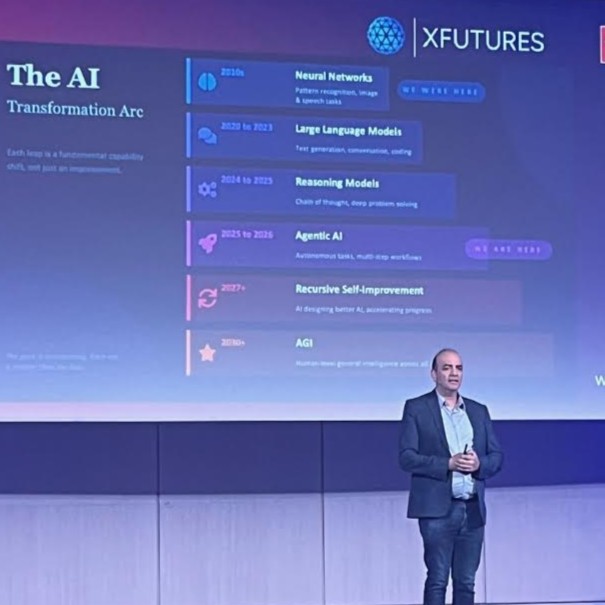
For the past few years, much of the AI conversation has focused on what these systems can generate: text, images, code, analysis and increasingly sophisticated answers. But we are entering a different phase. Agentic AI introduces systems that can pursue objectives, access tools and data, coordinate activities and execute increasingly complex workflows with varying degrees of autonomy. That changes the conversation fundamentally.
A chatbot that provides an inaccurate answer creates one type of problem. An autonomous agent that takes an incorrect action across interconnected systems creates
another. JoAnn Stonier's presentation on agentic AI and governance brought this distinction into focus. As systems become more autonomous, organizations need to think differently about accountability, oversight and the limits of delegation. Who is responsible when an agent makes a mistake? Who decides which actions require human approval? How do we design systems that remain understandable, controllable and aligned with organizational values?
These are not questions that can be solved by technology teams alone.
They require business leaders, designers, policymakers and employees to participate in shaping how AI operates.
The next competitive advantage may not be having the most autonomous AI, but knowing exactly where autonomy creates value and where human judgment
remains essential.
2. The most interesting AI transformations are not about AI
One of the most tangible examples came from the presentation on the UAE's ambitions for agentic government. H.E. Dr. Saeed Aldhaheri explored how public services could evolve from isolated digital transactions toward more integrated, proactive and AI-enabled experiences.
The examples presented included government agents supporting internal operations and agents acting on behalf of citizens, with consent, escalation and human oversight built into the service journey.
The ambition is substantial.
The UAE's plans presented at the summit envisage bringing agentic AI into a significant proportion of government services and operations. But the most interesting part was not the scale of technological adoption. It was the underlying transformation of the service model. Instead of asking people to navigate different government departments, complete repetitive forms and understand institutional structures, what if the system could organize itself around the person's actual need?
This is a profound shift in perspective.
And it applies far beyond public administration.
Banks, healthcare providers, mobility companies, retailers and industrial organizations face similar challenges. Their services have often been designed around internal departments, legacy systems and operational constraints. AI creates an opportunity to rethink those structures. But the opportunity will be wasted if we simply automate processes that were poorly designed in the first place. The objective should not be to make existing processes faster. It should be to question whether those processes should exist in their current form at all.
That is fundamentally a design challenge.
3. In a world obsessed with artificial intelligence, we need to understand human intelligence better
Perhaps the most thought-provoking contrast of the day came from the sessions exploring what it means to be human. Rafael Mira's presentation, The Human Being Map, challenged the fragmentation of our understanding of human behavior.
We study people through psychology, neuroscience, economics, anthropology, philosophy and many other disciplines. Each contributes valuable knowledge, yet integrating those perspectives into a coherent understanding of human experience remains difficult. That matters enormously as AI becomes embedded in our lives.
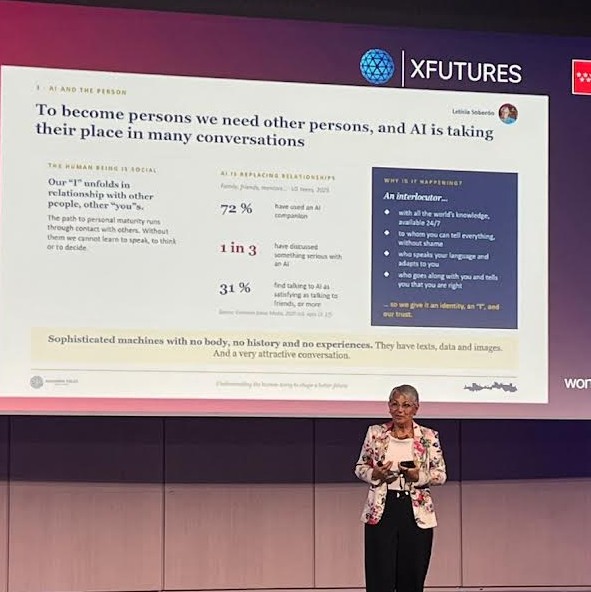
Another presentation, from Leticia Soberón, examined how artificial intelligence is beginning to occupy spaces traditionally reserved for human relationships.
AI companions can provide information, conversation and a sense of availability. For some people, these interactions may offer genuine benefits.
But convenience and connection are not necessarily the same thing. Relationships involve disagreement, vulnerability, shared experiences, physical presence and the ability to see the world through another person's perspective.
An AI system can simulate aspects of these interactions without necessarily reproducing what makes them meaningful.
This raises a challenging question for everyone designing products, services and experiences.
Just because technology can replace an interaction, should it?
Sometimes the most valuable experience is not the most frictionless one. Sometimes the conversation, the human intervention or even the disagreement is an essential part of the value.
As organizations seek to automate more customer and employee interactions, understanding this distinction will become increasingly important. Human-centered innovation should not mean making humans more compatible with technology. It should mean making technology more compatible with human needs.
4. AI governance is becoming a design discipline
Another recurring theme was the gap between the speed of AI adoption and organizations; ability to govern it.
The presentations highlighted familiar concerns: data quality, security, accountability, transparency, unclear business value and insufficient oversight.
Yet one idea stood out.
Governance should not be something organizations add after implementation.
It needs to be designed into the system from the beginning.
One framework presented a particularly useful sequence:
Values → Architecture → Guardrails
First, establish what the organization believes in and wants to protect. Then design the technical and operational architecture that reflects those commitments. Finally, establish the boundaries, controls and mechanisms that ensure those principles remain valid in practice. This changes how we think about responsible innovation.
Governance is not simply a compliance exercise or a collection of restrictions. Good governance helps organizations innovate with greater confidence because
responsibilities, expectations and acceptable risks are understood. It also forces teams to ask questions that are too often overlooked.
What are we optimizing for? Which outcomes matter? Who could be affected? What happens when the system behaves unexpectedly? Who can intervene?
In the age of agentic AI, designing accountability becomes as important as designing functionality.
Trust is not something a company can simply communicate.
It must be built into how its systems behave.
5. The real transformation will come from connecting technologies, people and systems
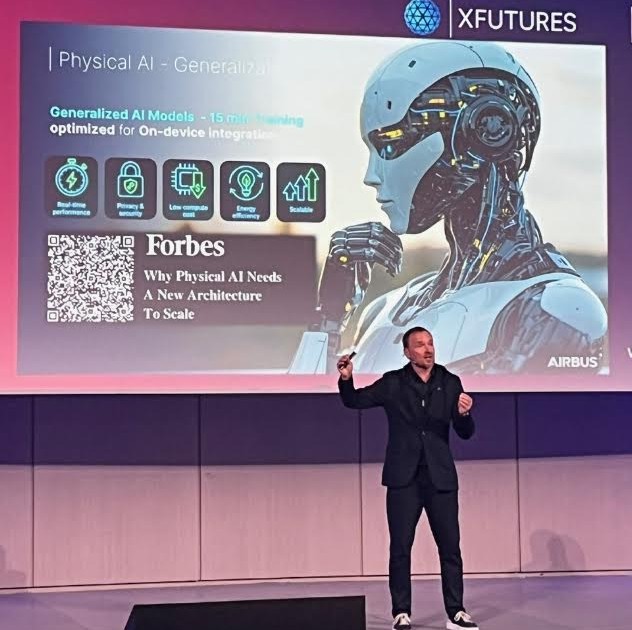
The presentation from Airbus offered another perspective on the scale of change underway. AI is no longer confined to software interfaces or knowledge work. Its applications are expanding across advanced manufacturing, robotics, physical systems, materials, energy and scientific research.
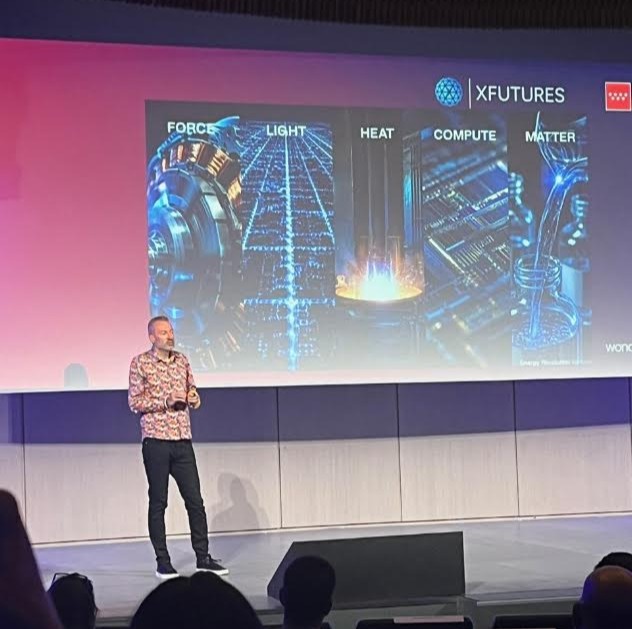
The broader technological landscape presented at the summit reinforced this convergence.
AI, robotics, biotechnology, advanced computing and other emerging fields are increasingly interconnected. The next breakthroughs may emerge not from a single technology but from combining several capabilities in ways that were previously impossible. This is exciting, but it also creates a challenge for organizations.
Traditional innovation models often divide responsibility across departments, technologies, products and business units. Yet the opportunities emerging from technological convergence rarely respect those boundaries.
They require systems thinking, interdisciplinary collaboration and the ability to connect technological possibilities with actual human needs. And perhaps most importantly, they require leaders who can think beyond immediate efficiency gains.
Because innovation is not simply about implementing what technology makes possible today.
It is about imagining what becomes valuable tomorrow.
The question we should be asking

We left XFutures with a sense of optimism, but also with a stronger conviction that we need to change the way we approach technological transformation.
We have become extraordinarily good at asking what technology can do.
Can AI automate this process? Can it perform this task? Can it reduce costs, increase speed or generate new capabilities?
These are legitimate questions.
But they are not sufficient.
We also need to ask what kind of organizations we want to build, which human capabilities we want to strengthen, what relationships we want to preserve and what experiences we want to create. In strategic design and innovation, this distinction is particularly important. Technology expands the range of what is possible. Design helps us decide what is desirable, valuable and worth bringing into the world. And leadership creates the conditions for making those choices responsibly.
As AI becomes more capable and autonomous, the need for these human disciplines will only increase.
Perhaps the greatest challenge of the AI era is not teaching machines to think more like humans.
It is making sure that, as our machines become more intelligent, we become more intentional about what it means to be human.
Let’s grow together!
次の成長戦略についてお悩みですか?
Mormediがその答えを導き出します